
Murray County Projected Versus Actual Release
Oklahoma uses the exact term Projected Release Date, often shortened to PRD. The Oklahoma Pardon and Parole Board glossary defines PRD as an ODOC estimate of when an offender will release. ODOC calculates it. The Board does not. Credits, programs, misconduct, sentence changes, and other lawful adjustments may move the estimate after it is first calculated.
An actual release date records the custody event that occurred. It should state whether the person entered the community or moved to another agency. That distinction is vital in Murray County. A person may leave Murray County Jail for ODOC, another county, tribal custody, federal custody, or immigration custody. Such a transfer ends one facility stay but continues confinement.
A pretrial detainee has no computed prison PRD. Bond, dismissal, a court order, another hold, or later sentencing may decide what happens. Even a court entry for bond or time served may precede jail processing. Ask the jail whether all holds cleared and whether the disposition was community release or transfer.
Murray County PRD Access Limits
Oklahoma's public access rule is unusually important. ODOC's current Offender Info FAQ says a particular inmate's release date is confidential to an ordinary inquirer absent a legitimate need, such as a judicial or law-enforcement need. It also calls the date tentative. The inmate receives days remaining each month and may calculate the estimate or ask the correctional records officer or case manager. The inmate may choose to share it.
This means the OK Offender Lookup should be used for the fields it actually displays, not for a promised public PRD. It may establish identity, ODOC number, photograph or physical descriptors, location or status, convictions, and sentence information. ODOC says the public result is abbreviated and is not an exact account of the offense, sentence, or time to serve. Record exact labels and resolve conflicts through ODOC documents and the court judgment.
The official FAQ is shown in the following capture from ODOC Offender Info.
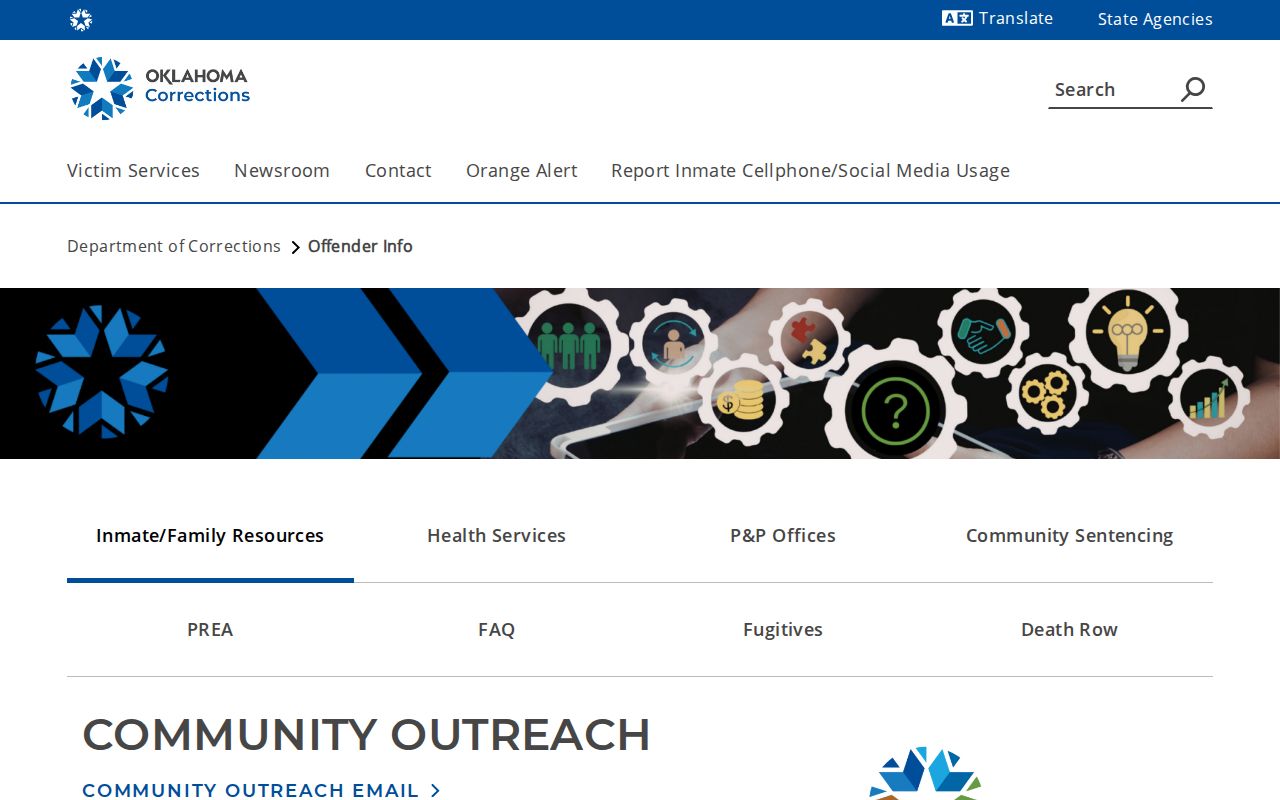
The capture supports both cautions: a case-specific date is restricted for ordinary requests, and any available estimate remains subject to change.
Note: Never infer a hidden PRD from a sentence length alone, since credits, sentence structure, and later legal events may alter the calculation.
Find a Murray County Projected Date
Classify the case before searching. A local bond release, a county-only sentence, and an Oklahoma prison sentence use different records. The Murray County release search and record route can identify the custody system when that first fact is unknown. Do not use an ODOC absence to conclude that a person left Murray County Jail. Many people released on bond, time served, dismissal, or a short local sentence never enter ODOC.
- Identify the arresting agency, holding facility, court case, and whether the person received an ODOC sentence.
- For state custody, accept the OK Offender Lookup disclaimer and search by ODOC number when known.
- Compare the name, number, physical details, conviction, and status before relying on a candidate record.
- Use only the sentence and date fields the live result actually provides. Do not promise a public PRD.
- For a county sentence, obtain the commitment and ask Murray County Jail how its release date was calculated.
- Request the calculation or credit record from the correct custodian if a formal answer is needed.
- Confirm the eventual physical event with ODOC, the jail release record, or the receiving agency.
Murray County Jail is at 700 W. 10th St., Sulphur, and its main line is 580-622-5106. No local public roster, release calculator, good-time policy, or release-hour policy was verified. Ask the records custodian for the booking number, exact release date and time, disposition, and destination. A transfer to ODOC is continued custody, not a community release.
Murray County Earned-Credit Framework
For ODOC sentences, 57 O.S. § 138 establishes earned-credit levels. The statutory structure is commonly represented as Level 1 with no monthly credits, Level 2 with 22, Level 3 with 33, and Level 4 with 44. Classification, exclusions, qualifying performance, and current law govern whether those figures apply. Authorized achievements may add credit. Misconduct or failure to perform may remove credit. Restoration may be considered under law and policy, but it is not guaranteed.
ODOC applies sentence administration through OP-060211. A sound conceptual formula is: court-imposed term and sentence structure, less lawful prior-custody credit, less earned and achievement credits, plus lost credits or adjustments, equals changing days remaining and a tentative PRD. It explains the parts. It is not a case calculator.
| Factor | Possible effect on the date | Record to check |
|---|---|---|
| Earned level | Eligible monthly credits may reduce days remaining. | ODOC classification and sentence record |
| Achievement | Authorized accomplishments may add credit. | ODOC achievement-credit entry |
| Misconduct | Credit loss may move the estimate later. | ODOC disciplinary and credit record |
| Prior-custody credit | Lawful jail credit may reduce remaining time. | Judgment and sentence calculation |
| Concurrent or consecutive terms | Sentence structure changes the total calculation. | Court judgment and ODOC administration record |
| Court amendment | A later order may change the controlling sentence. | Filed court order |
| Detainer or transfer | Departure from one facility may lead to more custody elsewhere. | Release disposition and receiving-agency record |
Do not apply the state credit table to a Murray County-only jail term without a controlling local or state rule. No Murray County Jail good-time or weekend-release policy was located. Obtain the commitment and ask the Sheriff for the actual calculation method.
Murray County 85 Percent Cases
Oklahoma's so-called 85% rule appears in 21 O.S. § 13.1. It applies to listed serious offenses, not every felony. A covered person must serve at least 85 percent of the imposed sentence before parole consideration. Reaching that point does not grant parole and does not establish a physical release date. Earned credits do not move the statutory parole-consideration floor earlier.
Coverage depends on the offense, offense date, judgment, sentence, and the version of law that controls the case. Parole eligibility is separate from PRD. Sections 57 O.S. §§ 332.7 and 332.8 contain category-specific eligibility and consideration rules. A universal one-third formula is unsafe. Consecutive terms, life sentences, statutory minimums, and exclusions may also affect the path.
Once eligible, the Board can deny, pass, grant nonviolent parole, or recommend violent-offender parole to the Governor. A recommendation may require executive action. ODOC processing then stands between the decision and the gate event. Keep eligibility date, Board action date, executive action, and actual release date as separate facts.
Note: The 85 percent point is a parole threshold for listed offenses, not an automatic Murray County release date.
Murray County Jail Date Calculations
A county-only sentence cannot be safely calculated with ODOC's state-prison credit system. Murray County did not publish a verified good-time table, weekend-release rule, online sentence calculator, or routine release schedule in the sources reviewed. The court commitment states the sentence, while the Sheriff processes custody and release. Ask both offices when the basis is unclear.
The request should identify the person and booking, then seek the commitment, credit calculation, release date and time, disposition, and destination. If staff says the person was “released,” ask whether that means community release or transfer. A disappearance from a live roster does not answer the question. Another warrant, case, detainer, or transport order can keep the person in custody after one legal basis ends.
A person sentenced to ODOC may remain in a county jail before state transport. Research from ODOC says the wait can be about six to nine months, though circumstances vary and timing is security-sensitive. Sentencing, state reception, transport, projected release, and actual community release are distinct milestones. Never date state release from the day a Murray County name disappears.
The court record can clarify the legal term but may not contain the jail's final processing detail. Search the Murray County docket by case number when possible and inspect the judgment, commitment, bond paperwork, sentence modification, revocation, or satisfaction entry that relates to the date. Municipal ordinance cases in Sulphur or Davis may not appear in the statewide docket system, so the applicable municipal court may own that part of the record. If Chickasaw jurisdiction applies, a tribal or federal court can be the correct source. No court entry should be turned into a gate time unless the jail or prison confirms the physical event.
For a written county request, identify the full name and date of birth or booking number, then ask for the booking date, sentence authority, applied credit, exact release time, release reason, and receiving agency after any transfer. No Murray County fee schedule, request form, public counter hours, or response promise was verified. Call the jail for its current submission method and ask for a written estimate before costs are incurred. The absence of a published procedure does not justify borrowing a form, fee, or timetable from another Oklahoma county.
Confirm Murray County Actual Release
Use the source that controlled the custody event. For Murray County Jail, request its booking and release record. For state prison, use ODOC's status and formal discharge or release documentation. If the record says transfer, follow the named receiving agency. A court docket explains legal authority but usually does not prove the moment the person crossed the facility threshold.
For a pending event, VINE Inmate Check explains how to search a matching record and register for custody-change alerts. OK VINE receives data from participating Oklahoma agencies and may send release, transfer, escape, apprehension, or death notices. An alert is a prompt to verify. It is not a certified release record and cannot rule out a later hold.
ODOC Victim Services identifies VINE as its main release-notification route and lists 405-425-2607 for applicable inquiries. For records, ODOC Legal Services lists osordischarges@doc.ok.gov for discharge requests and Closed Records at 405-425-2691. Some file content is confidential. Use the ODOC number and ask for a specific document instead of a broad file request.
When official sources differ, keep an “as of” date for each one. A court order may be entered before facility staff completes release processing. ODOC may later recalculate credits or receive another order. VINE may post a custody event after the source system updates. Ask each originating office whether its record was later changed, rather than selecting the date that seems most convenient.
A final statement should preserve scope: released from which agency, on what date, through what disposition, and to what destination. That wording separates a true return to the community from a move into another custody system.